📘 SEBI Registered Research Analyst: Why It Matters Before You Invest (Simple Guide)
💡 “Would you visit a doctor who doesn’t have a medical license?”
Probably not.
You’d want someone who is qualified, follows professional standards, and is accountable for their work.
The same logic applies when choosing someone for stock market research.
Thousands of people share stock tips every day on 📺 YouTube, 💬 Telegram, 📱 WhatsApp, 📸 Instagram, and other platforms. Some may have experience, while others may simply be sharing opinions.
So how do you know who is operating under a regulatory framework?
One of the first things you can check is whether they are a SEBI Registered Research Analyst.
The stock market offers opportunities for wealth creation, but it also involves risk. With a growing number of market-related websites, social media channels, and advisory services, investors may find it difficult to distinguish between regulated research providers and unregistered entities.
One of the simplest ways to make an informed choice is to check whether the research provider is a SEBI Registered Research Analyst (RA).
This article explains what a SEBI Registered Research Analyst is, why registration matters, and what investors should know before subscribing to research services.
📖 What is a SEBI Registered Research Analyst?
A SEBI Registered Research Analyst (RA) is an individual or entity registered with the Securities and Exchange Board of India (SEBI) under the SEBI (Research Analysts) Regulations, 2014.
Research Analysts are permitted to prepare and distribute research reports and investment research in accordance with the applicable regulatory framework. They are required to comply with SEBI regulations, disclosure requirements, and prescribed standards of conduct.
✅ Why SEBI Registration Matters
🛡️ 1. Regulatory Oversight
SEBI regulates registered Research Analysts through a structured compliance framework.
Registered entities are expected to comply with applicable regulations, maintain required records, follow disclosure requirements, and adhere to professional standards prescribed by SEBI.
📄 2. Transparent Disclosures
A SEBI Registered Research Analyst is required to provide relevant disclosures wherever applicable, including information related to conflicts of interest and regulatory status as prescribed under SEBI regulations.
Such disclosures help investors understand the context in which research is provided.
⚖️ 3. Defined Code of Conduct
Research Analysts are required to follow a professional Code of Conduct, which includes principles such as:
- ✔️ Integrity and fairness
- ✔️ Due diligence
- ✔️ Professional competence
- ✔️ Objectivity
- ✔️ Confidentiality
- ✔️ Compliance with applicable regulations
These standards are intended to promote responsible research practices.
🎯 4. Investor Awareness
Before using research services, investors should verify important details such as:
- ✔️ SEBI Registration Number
- ✔️ Validity of registration
- ✔️ Official website
- ✔️ Risk disclosures
- ✔️ Terms and conditions
- ✔️ Fee-related information, wherever applicable
Conducting these checks helps investors make informed decisions.
💭 Imagine This…
Rahul is new to the stock market.
While scrolling through social media, he sees two advertisements.
❌ Advertisement A
“Join today! Guaranteed 10% profit every month. Become rich quickly!”
✅ Advertisement B
“Research services provided by a SEBI Registered Research Analyst. Please read the disclosures and understand the risks before investing.”
Which one sounds more trustworthy?
The second advertisement doesn’t promise guaranteed profits. Instead, it encourages investors to understand the risks and review the disclosures.
That’s the type of communication expected under SEBI regulations.
🚗 What Does “SEBI Registered” Actually Mean?
Think of it like getting a driving licence.
Anyone can buy a car.
But only someone with a valid driving licence is legally permitted to drive on public roads.
Similarly, many people discuss the stock market online, but Research Analysts who provide regulated research services are required to obtain registration from SEBI and comply with applicable regulations.
Registration does not mean the analyst is always right.
It means they are expected to operate within a regulatory framework and follow prescribed compliance requirements.
🤔 Why Should Investors Care?
Imagine you’re buying a mobile phone online.
Would you purchase it from:
- ✅ A verified seller with complete details and customer support?
- ❌ Or an unknown seller with no identity and only promises?
Most people choose the verified seller because there is greater transparency.
The same principle applies when evaluating research providers.
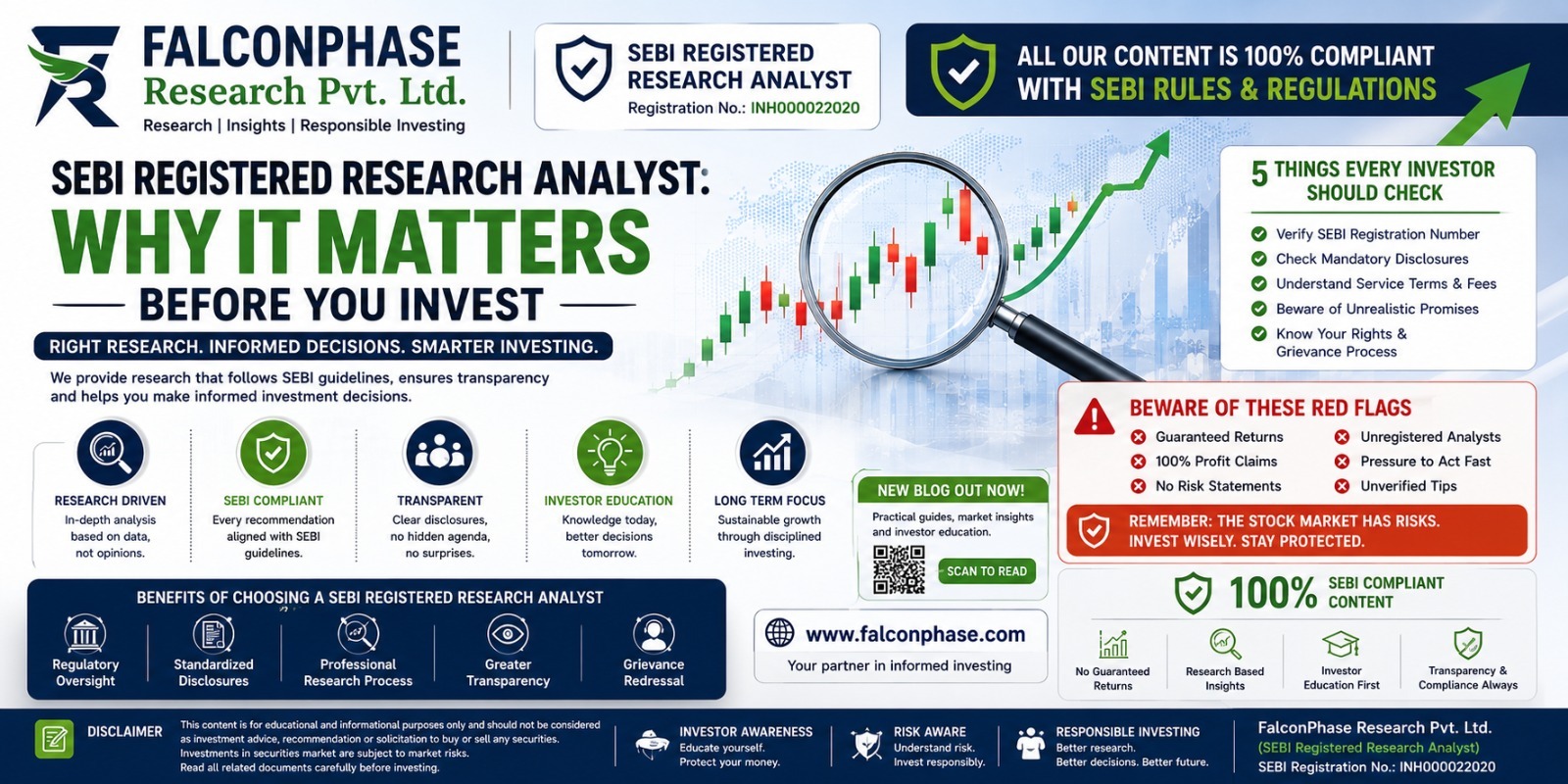
📝 Five Things Every Investor Should Check
1️⃣ Is the Research Analyst registered with SEBI?
Look for the registration number.
If it isn’t disclosed, ask for it.
2️⃣ Are all required disclosures available?
A responsible research provider generally makes required disclosures available to clients as prescribed under applicable regulations.
3️⃣ Are there promises of guaranteed returns?
Be cautious if you see statements such as:
❌ “100% Profit”
❌ “Guaranteed Monthly Income”
❌ “No Risk”
The securities market involves risk, and investment outcomes cannot be guaranteed.
4️⃣ Is the fee structure clear?
Understand what services are included, the subscription period, and applicable charges before making any payment.
5️⃣ Is customer support available?
Professional organizations generally provide official contact details and grievance redressal mechanisms.
❗ Common Myth
“If a company is SEBI Registered, I’ll definitely make money.”
This is one of the biggest misconceptions.
SEBI registration is not a guarantee of profit.
Think about wearing a seat belt.
A seat belt improves safety, but it doesn’t guarantee that an accident will never happen.
Similarly, SEBI registration reflects a regulatory framework—not assured investment returns.
🍽️ A Simple Analogy
Imagine two restaurants.
✅ Restaurant A has:
- Hygiene standards
- Proper licences
- Food safety inspections
❌ Restaurant B has:
- No licence
- No transparency
- Only advertisements claiming to be “the best”
Which one would you choose?
Most people prefer the licensed restaurant because it operates under established rules.
The same thinking can help when selecting a research provider.
🔍 How Can You Verify a Research Analyst?
Before subscribing:
- ✔️ Check the SEBI registration number.
- ✔️ Visit the official website.
- ✔️ Read the disclosures.
- ✔️ Understand the terms and conditions.
- ✔️ Ask questions if anything is unclear.
Taking a few minutes to verify these details can help you make a more informed decision.
📌 Final Thoughts
A SEBI Registered Research Analyst is expected to follow applicable regulations, disclosure requirements, and professional standards. However, no registration can eliminate market risk or guarantee returns.
The best approach is to combine careful research, realistic expectations, and disciplined investing.
💡 Remember:
“Choose research based on transparency and informed decision-making—not on promises of guaranteed profits.”
⚠️ Disclaimer
FalconPhase Research Pvt. Ltd. is a SEBI Registered Research Analyst (Registration No. INH000022020).
This article is published solely for educational and informational purposes and should not be construed as investment advice, investment recommendation, solicitation, or an assurance of returns. Investments in the securities market are subject to market risks. Readers should carefully read all related documents, evaluate their own financial circumstances, and seek independent professional advice before making any investment decision.