📈 How to Select Stocks: A Step-by-Step Guide for Smart Investing (Easy Language)
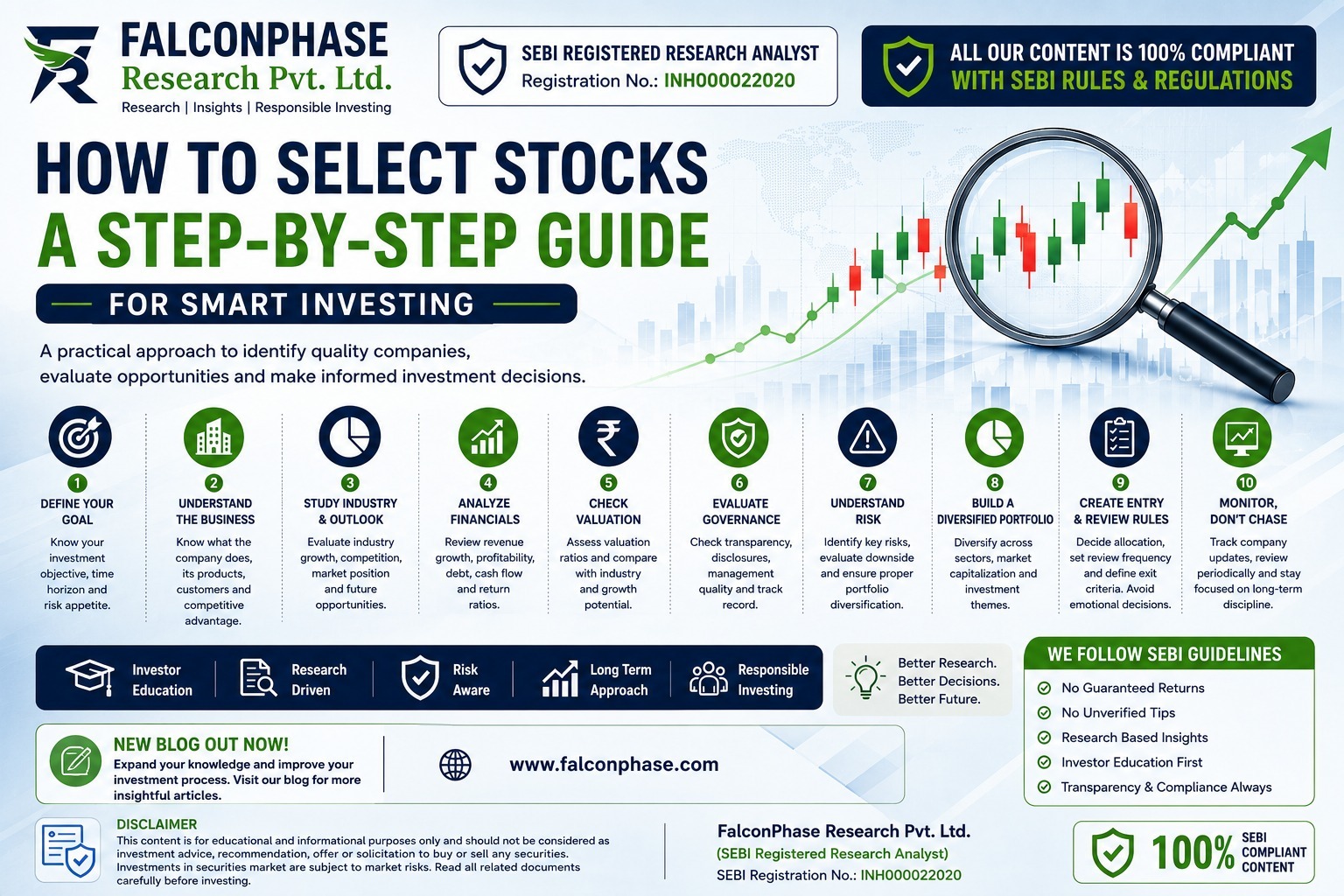
📚 Learn how to select stocks step by step in simple language with practical examples. Understand business, financial analysis, diversification, risk management, and investor awareness before investing.
Investing in the stock market can look exciting, but selecting stocks should not depend only on market noise, social media trends, or emotions.
A disciplined and research-based approach may help investors make more informed decisions.
🎯 Step 1: Decide Your Investment Goal
Before selecting any stock, ask:
- ✅ Why am I investing?
- ✅ What is my investment period?
- ✅ How much risk can I handle?
📝 Example:
Rahul has ₹1,00,000.
He decides:
- 💰 ₹70,000 for long-term investing
- 🛡️ ₹30,000 for emergency reserve
Now Rahul has a clear objective.
🏢 Step 2: Understand the Business
Before selecting a company, understand:
- 📦 What products or services it provides
- 💵 How it earns revenue
- 📈 Whether the business can grow over time
📝 Example:
Company A
- ✅ Provides products used regularly
- ✅ Stable business model
Company B
- ❌ Business difficult to understand
- ❌ No clear growth direction
📌 Simple Rule
Do not invest in a business you cannot explain simply.
📊 Step 3: Study Industry and Growth Potential
Review:
- 📈 Industry growth
- 🏆 Competition
- 🌍 Market position
- 📉 Demand outlook
📝 Example
Technology, healthcare, banking, and manufacturing industries all behave differently.
Understanding the industry helps improve decision-making.
💹 Step 4: Check Financial Health
Review areas such as:
- 📈 Revenue Growth
- 💰 Profit Trend
- 🏦 Debt Level
- 💵 Cash Flow
- 📊 Return Ratios
Examples
- ROE
- ROCE
📌 Do not depend on one number only.
💲 Step 5: Review Valuation
Look at:
- 📉 P/E Ratio
- 📈 Business growth
- 📅 Historical comparison
- 🏭 Industry comparison
📝 Example
Low price does not automatically mean cheap.
A ₹100 stock may not always be better than a ₹2,000 stock.
🛡️ Step 6: Evaluate Corporate Governance
Review:
- 📄 Public disclosures
- 🔍 Transparency
- 📢 Company updates
- 👔 Management communication
Strong governance supports informed investing.
⚠️ Step 7: Understand Risk Before Investing
Ask yourself:
- ❓ What if the market falls?
- ❓ What is my maximum acceptable loss?
- ❓ Am I diversified?
🚫 Avoid
- ❌ Investing emotionally
- ❌ Following rumors
- ❌ Concentrating all money in one stock
🌍 Step 8: Build a Diversified Portfolio
Diversification means spreading investments.
🏢 Sectors
- 🏦 Banking
- 💻 Technology
- 🏥 Healthcare
- 🛍️ Consumer Businesses
📊 Market Capitalization
- 🔵 Large-cap
- 🟠 Mid-cap
- 🔴 Small-cap
🎯 Investment Themes
- 📈 Long-term growth
- ⚖️ Stability-oriented investing
- 💵 Income-oriented approach
Diversification helps manage concentration risk.
📝 Example
Instead of putting ₹1,00,000 into one stock, an investor may evaluate spreading exposure according to personal goals and risk.
📅 Step 9: Create Entry and Review Rules
Before investing:
- ✔ Decide allocation
- ✔ Set review frequency
- ✔ Define review and exit criteria
📝 Example
Riya decides:
- 💰 Invest gradually
- 📅 Review quarterly
- 🔄 Reassess when business fundamentals change
Avoid daily emotional decisions.
👀 Step 10: Monitor, Don’t Chase
After investing:
- 📢 Track company updates
- 📊 Review fundamentals periodically
- 🎯 Stay disciplined
🚫 Avoid
- ❌ Checking price every few minutes
- ❌ Buying because everyone else is buying
- ❌ Frequent emotional decisions
Long-term discipline matters.
✅ Simple Stock Selection Checklist
Before investing, ask:
- ☑️ Do I understand the business?
- ☑️ Do I know my investment goal?
- ☑️ Did I review financial information?
- ☑️ Do I understand risk?
- ☑️ Am I diversified?
- ☑️ Am I investing with discipline?
❓ Frequently Asked Questions (FAQ)
1️⃣ What is the first step in selecting stocks?
Start by defining your goals, time horizon, and risk understanding.
2️⃣ Should I buy stocks because social media recommends them?
Investment decisions should not rely only on trends or market excitement.
3️⃣ Is low stock price equal to good investment?
No. Business quality and valuation both matter.
4️⃣ Is diversification important?
Diversification may help manage concentration risk.
5️⃣ How often should investments be reviewed?
Review frequency depends on goals and investment style.
6️⃣ Can stock market returns be guaranteed?
Markets involve uncertainty and outcomes cannot be assured.
7️⃣ Is research important before investing?
Research and informed decision-making help investors evaluate opportunities.
📋 Compliance & Investor Awareness Notes
Investors should make decisions using:
- 📌 Their own assessment
- ⚠️ Understanding of risks
- 📄 Available public disclosures
- 🎯 Suitability of investment decisions
Good investor practices commonly emphasize:
- ✔ Fair communication
- ✔ Appropriate disclosures
- ✔ Transparent engagement
- ✔ Avoidance of misleading claims
- ✔ Maintaining records and informed decision-making
📌 Past performance should not be treated as a guarantee of future results.
⚖️ Disclaimer
📖 This article is published for educational and informational purposes only.
This content should not be interpreted as investment advice, stock recommendation, portfolio management service, solicitation, assurance, or promise of returns.
📉 Investment decisions involve market risks. Readers should independently evaluate suitability before making decisions.
⚠️ Investments in securities markets are subject to market risks. Read all related documents carefully before investing.